News
 BACK TO LIST
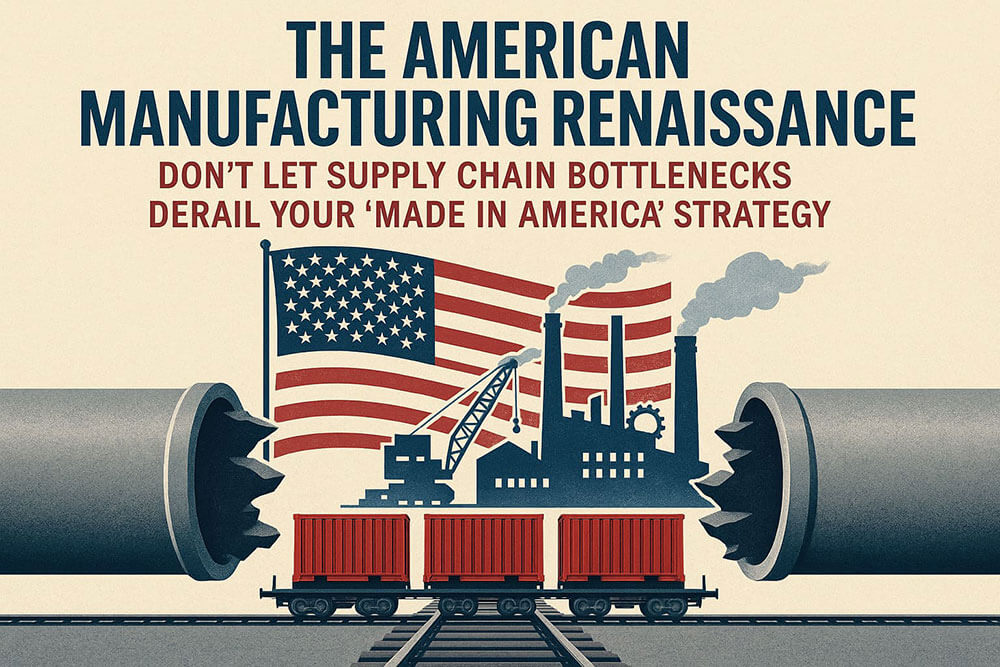
Introduction: The Horn of American Manufacturing Sounds Again
This article will delve into the core challenges of this American manufacturing resurgence, specifically for design and procurement personnel in high-precision equipment industries. We will reveal why traditional component procurement models can no longer meet the demands of this new era and introduce a hidden champion from Taiwan—SYK (Sung Yang Industrial)—and how its unique business model provides the critical speed and stability for this industrial revolution.
A powerful wave is sweeping across America's industrial landscape. "Made in America" is no longer just a nostalgic slogan; it is a monumental transformation happening right now. From semiconductor fabs in Texas to electric vehicle battery plants in the Midwest and precision medical device production lines on the East Coast, manufacturing is returning to the United States with unprecedented determination and scale.
A powerful wave is sweeping across America's industrial landscape. "Made in America" is no longer just a nostalgic slogan; it is a monumental transformation happening right now. From semiconductor fabs in Texas to electric vehicle battery plants in the Midwest and precision medical device production lines on the East Coast, manufacturing is returning to the United States with unprecedented determination and scale.
- The Fragility of Global Supply Chains: Recent global events have starkly revealed the risks of over-reliance on a single overseas market. From port congestions to geopolitical tensions, supply chain disruptions have become a regular threat to business operations.
- Powerful Government Policy Drivers: Policies led by the CHIPS and Science Act are funneling hundreds of billions of dollars to incentivize critical industries like semiconductors to establish complete ecosystems—from R&D to manufacturing—on American soil.
- The Pursuit of Speed and Flexibility: In a rapidly changing market, moving production closer to home means being closer to customers, enabling shorter product iteration cycles and greater customization capabilities.
This manufacturing renaissance is not merely about reopening old factories. It is an industrial upgrade centered on automation, intelligence, and precision. The new American factory will be a highly automated, data-driven hub, relying on sophisticated robots, CNC machine tools, and inspection equipment to maintain a global competitive edge.
However, within this landscape of opportunity, a hidden challenge is quietly emerging—one capable of bringing multi-billion-dollar investments to a grinding halt. This challenge lies not in the grand factory construction or advanced software systems, but in the stable supply of the precision mechanical components that form the foundation of it all. When your multi-million-dollar piece of equipment cannot be assembled because a small ball screw support unit is delayed, the entire grand vision of "Made in America" faces a severe test.
Chapter 1: The New Reality of American Manufacturing: Where Speed and Precision Reign Supreme
Reshoring is not just a geographical shift; it is a fundamental change in manufacturing philosophy. In the past, companies moved manufacturing abroad to pursue lower labor costs. Today, companies are bringing manufacturing back to pursue higher production efficiency, quality stability, and supply chain resilience. This means the new generation of American factories must achieve unprecedented levels of automation to offset higher labor and operational costs.
This places extremely demanding requirements on automation equipment, especially in the three core industries this article focuses on:
- The Semiconductor Industry: A War Fought at the Nanometer Scale
Driven by the CHIPS Act, the United States is aggressively rebuilding its leadership in semiconductor manufacturing. From Arizona to Ohio, massive wafer fabs are rising from the ground. At the heart of these factories are various types of precision inspection and process equipment, such as:
- Automated Optical Inspection (AOI) / Solder Paste Inspection (SPI) Equipment: This equipment performs high-speed scans over large wafers or PCBs to detect micron- or even nanometer-level defects. The smoothness, positioning accuracy, and vibration suppression of their gantry systems directly determine the yield and efficiency of the inspection process.
- X-ray Inspection (AXI) / In-Circuit Test (ICT) Equipment: For high-density packages like BGAs or Flip-Chips, AXI equipment must precisely move an X-ray emitter and detector for non-destructive testing. Any minute mechanical clearance or vibration will result in blurry images and misjudgments.
In this equipment, the Ball Screw is the soul of precision linear motion. The role of the Ball Screw Support Unit is like the "spine" of this motion axis. It must not only withstand the immense axial loads generated during movement but also, through its internal precision bearings (typically angular contact ball bearings), eliminate axial backlash to ensure that every positioning command is flawlessly accurate. A support unit of inconsistent quality can lead to positioning errors, vibration, and even shorten the lifespan of the expensive ball screw—an unacceptable outcome in the fast-paced semiconductor industry.
- The PCB Industry: The Challenge of Stability Under High-Speed Operation
The Printed Circuit Board (PCB) is the foundation of all electronic products. With the advancement of 5G, AIoT, and high-end servers, PCBs have more layers, denser circuits, and smaller drill holes than ever before. This presents a dual challenge for PCB drilling and routing machines:
- PCB Drilling Machines: Modern drilling machine spindles can reach speeds of hundreds of thousands of RPM. The Z-axis must perform reciprocating movements at extremely high acceleration, drilling tens of thousands of tiny holes in hard, stacked boards. This creates immense impact loads and high-frequency vibrations on the Z-axis ball screw and its support unit. The support unit must possess exceptional rigidity and damping characteristics to absorb these vibrations and ensure drilling position accuracy.
- PCB Routers/Depaneling Machines: These machines use high-speed milling cutters to cut PCBs along a predefined path. The accuracy and acceleration/deceleration performance of their X-Y motion platforms directly impact the smoothness and dimensional accuracy of the cut edges. Here, the Servo Motor Bracket plays a crucial role. It must securely mount the servo motor to the machine frame and ensure the perfect alignment of the motor shaft with the ball screw shaft. Any misalignment will create stress on the coupling, not only causing wear on the parts but also directly affecting the positioning accuracy of the motion platform.
For design engineers at PCB equipment companies, what they need are transmission components that can maintain long-term stability and precision under harsh operating conditions.
- The CNC Machine Tool Industry: The Ultimate Pursuit of Heavy Loads and High Dynamics
CNC machine tools are the mother of industry, and high-end 5-axis CNC milling machines and grinders are essential for manufacturing molds, aerospace parts, and precision medical devices. The characteristics of this equipment are:
- Heavy-Load Machining: When milling or grinding hardened steel, the ball screw and its support unit must withstand enormous cutting forces. The fixed end of the support unit must provide unparalleled rigidity to prevent the screw from bending or displacing under pressure.
- High Dynamic Performance: 5-axis machining requires complex, synchronized movements across multiple axes, demanding extremely high response speeds from the servo system. The servo motor bracket, in addition to providing a stable mount, must also aid in heat dissipation to ensure the motor does not lose performance due to overheating under heavy loads.
In these applications, component reliability is everything. A single instance of unexpected downtime can result in losses of tens or even hundreds of thousands of dollars. Therefore, procurement officers and design engineers at machine tool companies have an uncompromising demand for supplier quality stability.
In summary: The core of the new American manufacturing is the ultimate pursuit of automation, speed, and precision. Whether in the semiconductor, PCB, or CNC machine tool industry, the performance of the equipment is deeply rooted in seemingly inconspicuous precision components like ball screw support units and servo motor brackets. They are the unsung heroes, the foundational stones upon which the grand blueprint of "Made in America" is built. Yet, it is these critical cornerstones that are becoming the biggest supply chain bottleneck for many companies in the reshoring process.
Chapter 2: The Procurement Dilemma: Why Traditional Supply Chains Falter in the New Era
Amid the fervor of the American manufacturing comeback, the design and procurement teams of many equipment manufacturers are finding themselves in a new predicament. Their accustomed global sourcing strategies are proving to be ill-suited to the urgent demands of localized production.
The Pain Points of Procurement Personnel: Uncontrollable Lead Times and Soaring Inventory
A senior procurement manager at a large automation systems integrator shared his frustration: "On one of our new projects, we were designing a brand-new automated production line for a reshoring electronics company. The design team finalized the component selection early on, but we got stuck on some key transmission parts. The lead time from our usual European supplier stretched from the previous 4 weeks to 12 weeks for standard parts. For custom parts, it was indefinite. This directly threatened our project delivery schedule."
This is not an isolated case but a widespread phenomenon. The pain points of the traditional supply chain model have been magnified infinitely in the post-pandemic era:
- Long and Unpredictable Lead Times: Many European, American, or Japanese brands, despite their excellent quality, have globally dispersed production bases and overly long supply chains. From placing an order to production scheduling, manufacturing, international shipping, and customs clearance, a delay in any single step can trigger a chain reaction. This fills project timelines with uncertainty.
- High Inventory Costs and Risks: To cope with long lead times, companies are forced to maintain high levels of inventory. This not only ties up a significant amount of working capital but also increases warehouse management costs. Worse, if a design change occurs, these pre-purchased components can become obsolete overnight, resulting in huge losses.
- Inflexible Customization Services: When a design engineer needs a non-standard sized motor bracket or needs to add a special mounting hole to a support unit, traditional large suppliers often respond slowly, charge exorbitant customization fees, and quote lead times in months. This severely limits design flexibility.
- Inefficient Communication: Communicating across time zones and languages often leads to delays and misunderstandings in information transfer. A simple technical question might take days to get a response, which is fatal in the race-against-time R&D phase.
The Designer's Dilemma: Compromising Between the Ideal and the Reality
For mechanical design engineers, their goal is to design equipment with optimal performance and the most reasonable cost. However, supply chain constraints often force them to compromise.
An engineer responsible for PCB equipment module design stated: "In the early design stage, I select the ideal screw and support unit models based on load, speed, and precision requirements. But I have to hand the selection list over to the procurement department for them to confirm lead times. More often than not, my ideal choice is unavailable within the project timeline. I have to settle for a substitute with slightly inferior performance but is 'in stock.' This compromise means the final performance of the equipment might be compromised."
The dilemmas faced by designers include:
- Limited Design Freedom: Fearing the long lead times for custom parts, engineers tend to use "standard parts" in their designs, even if it means the mechanical structure has to be more complex or bulkier to accommodate the standard component dimensions.
- Slowed Pace of Innovation: An innovative design often requires customized parts to be realized. If the supplier cannot quickly provide samples for testing and validation, the entire R&D cycle is severely delayed.
- Lack of Information Transparency: When selecting components, engineers not only need accurate 3D models and specification sheets but also hope to quickly obtain technical support regarding the part's practical application performance, installation tips, etc. The sales or customer service systems of traditional suppliers often struggle to provide such in-depth and immediate technical dialogue.
In conclusion, the traditional component supply chain, based on planned production and global division of labor, can no longer meet the agility and speed required by the new American manufacturing. American equipment manufacturers are in urgent need of a new type of supply partner—one that can not only provide high-quality products but also deliver fast, stable, and flexible supply services, becoming a trusted pillar for companies navigating the wave of localization.
Chapter 3: The SYK Solution: Injecting Taiwanese Speed and Flexibility into American Manufacturing
Just as American manufacturers were struggling in the supply chain quagmire, a precision component manufacturer from Taiwan—SYK (Sung Yang Industrial)—offered a distinctly different answer. Since its establishment in 1989, SYK started as an OEM for precision mechanical parts and gradually developed its own brand of products centered on Ball Screw Bearing Blocks and Servo Motor Mounting Brackets. SYK's success is no accident; it is built on a profound insight: In the field of precision motion, control over quality begins with complete mastery of the process.
SYK's core philosophy is simple yet extremely powerful: "Stable Quality, Fastest Delivery Time, Reasonable Price." The secret weapon to achieving all this is its proud "One-Stop, Vertically Integrated Production Line."
The One-Stop Production Line: Controlling Quality and Speed from the Source
Unlike many brands that outsource production, SYK completes the entire process from raw material to finished product within its own factory. What does this mean?
- Turning: Precisely machining round bar stock into the initial shapes of support units and motor brackets.
- Milling: Performing secondary machining such as creating flat surfaces, grooves, and holes to shape the product's precise geometry.
- Grinding: Performing precision grinding on critical dimensions like the bearing mounting bore and end faces to achieve micron-level tolerances and surface finishes. This is the core process that guarantees the support unit's precision.
- Surface Treatment: Enhancing the product's corrosion resistance and appearance through processes like anodizing or chemical plating.
- Assembly: In a clean environment, preloading and installing carefully selected, high-quality Japanese bearings into the support unit housing.
- Quality Control: Using precision instruments like Coordinate Measuring Machines (CMMs), roundness testers, and surface roughness testers to conduct rigorous inspections on every product before it leaves the factory.
- Warehousing & Packing: Systematically managing finished products in inventory and, upon receiving an order, quickly and securely packing them for shipment.
This "one-stop" production model gives SYK an unparalleled competitive advantage and perfectly addresses the pain points of its American customers:
1. Unshakeable Quality Stability
Because every process step is under its own control, SYK can ensure quality consistency from the source. From the choice of materials and tool settings to the precision of the grinding and the preload value of the bearings, all key parameters are standardized and strictly executed by experienced technicians. This means the 1st product and the 1,000th product a customer receives are of the same quality. For the demanding semiconductor and CNC industries, this predictable stability is the cornerstone of reducing equipment failure rates and improving yield.
2. Industry-Disrupting, Ultra-Fast Lead Times
This is SYK's core competency that truly wows customers. By eliminating the need to wait for external suppliers, combined with efficient internal process management and a substantial inventory of standard parts, SYK can achieve astonishing delivery speeds:
- Standard Parts: Ship within 1-3 days
- Custom Parts: Ship within 5-7 days
Imagine this: while your European supplier is still replying to emails to confirm order details, SYK's shipment could already be on its way to the United States. For the procurement manager and design engineer mentioned earlier, this means:
- No More Project Delays: They can get the required parts almost immediately after the design is finalized, drastically shortening the equipment assembly and testing cycle.
- Instant Relief from Inventory Pressure: There's no longer a need to procure and hoard parts months in advance. Customers can adopt a leaner, "Just-in-Time" model, placing orders only when needed, which significantly reduces inventory costs and management pressure.
- Unhindered Design Iteration: Design engineers can confidently pursue innovative designs, knowing that even if they need a custom prototype, they can have it in hand for validation in just one week. This greatly accelerates the product development speed.
3. Powerful Support for Flexible Customization
SYK's vertical integration model allows it to exhibit incredible flexibility when handling customization requests. Often, what design engineers need is not a completely new design from scratch, but minor modifications to a standard product, such as:
- Changing the size or position of mounting holes to match a special machine structure.
- Designing a special cable outlet for a servo motor bracket.
- Adjusting the overall height of a support unit to fit into a limited installation space.
For many large suppliers, such "low-volume, high-mix" requests often disrupt their production rhythm, making their response slow and costly. But for SYK, this is just a routine task of adjusting a CNC program or fixture. They have the capability to quickly meet customers' flexible needs without sacrificing lead time. This makes SYK not just a parts supplier, but more like a collaborative "external machining department."
Service Tailored for American Customers
SYK understands that to serve the U.S. market well, having a great product isn't enough. They are committed to providing a seamless customer experience:
- Professional Technical Communication: Their sales team has a deep technical background, enabling them to speak directly with design engineers, understand their application needs, and provide professional selection advice.
- Clear Product Data: They provide complete and accurate 2D/3D model downloads, making it easy for engineers to import them directly into their CAD software for design.
- Reliable Logistics Partners: They partner with internationally renowned logistics companies to ensure that goods can be delivered quickly and safely from Taiwan to any corner of the United States.
By combining "Made in Taiwan precision quality" with "response speeds that rival local suppliers," SYK offers a perfect solution for companies striving to realize their "Made in America" goals. They allow American design and procurement personnel to avoid making the painful choice between "quality" and "speed."
Conclusion: Win at the New Starting Line of American Manufacturing by Choosing the Right Partner
The return of American manufacturing is a long-term battle for national competitiveness, technological sovereignty, and supply chain security. The outcome of this battle depends not only on grand policies and investments but also on every detail at the execution level. For automation equipment manufacturers on the front lines, the ability to find a responsive, high-quality, and trustworthy component supply partner will be one of the key factors determining their success or failure.
The traditional, lengthy global supply chain has proven its fragility in the face of volatility and uncertainty. Continuing with the old procurement mindset is akin to shackling your own American reshoring plan with heavy chains. The high hidden costs—project stagnation due to delivery delays, performance degradation from design compromises, and capital tied up in excessive inventory—will slowly but surely erode a company's profits and competitiveness.
The emergence of SYK (Sung Yang Industrial) is perfectly timed.
They represent a new type of supply philosophy. Through "one-stop vertical integration," SYK holds the reins of quality and lead time firmly in its own hands.
- For Design Engineers, SYK means "design freedom." You no longer need to compromise for the sake of lead times. You can boldly use the most suitable parts and even get fast customization based on standard products to achieve the most optimized mechanical design.
- For Procurement Personnel, SYK means "supply chain resilience." The ultra-fast lead times of 1-3 days for standard parts and 5-7 days for custom parts allow you to bid farewell to the nightmare of high inventory, effectively reduce operating costs, and ensure your production lines never stop.
In this era of change, your supplier is an extension of your team. An excellent supply partner should help you deliver the right product at the right time. SYK plays precisely this role. What they offer is not just high-quality ball screw support units and servo motor brackets, but also a precious certainty—in a world full of uncertainty, you can trust their speed, quality, and commitment.
Is your "Made in America" project being hampered by unstable component supplies? Are your designs constrained by long lead times for customization?
It's time for a change.
Contact our team today to explore our products, download technical specifications, and let us show you how a truly agile and reliable supply chain partner can give your American manufacturing business a strong boost.